
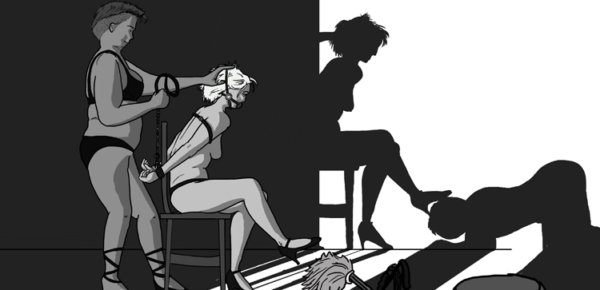
Turning the Tables – Defining a Switch
When we think about BDSM we have long thought of Dominance and submission but what is Defining a Switch. More recently we have thought of Christian Grey and Anastasia Steele whether we agree or disagree with E.L James’ portrayal of the kinky genre. Surveys have shown that worldwide over 90% of people have thought more than once about BDSM. But there is an aspect of the kinky rabbit hole that seems to go unnoticed, left in the dark or does not get as much attention, recognition or information.
Switching.
More often than not, people will often label themselves as Dominant or Submissive. Not all of the time though, they are not 100% on that scale. Let me paint you a crude expression in the form of a picture.
Most people will fluctuate somewhere along this rudimentary scale. There will be Submissives who are more submissive than others, and Dominants who are more overtly dominantly foreboding. It comes down to the same way that no two personalities are going to be the same.
And then there are Switches. Switches are not those who cannot decide, so let us quash that myth right here and now. They are also not greedy and want to both. Another myth that we can dispel. Switches can be submissives and can also be dominants.
But, ultimately, switches like the power exchange, switches enjoy both taking power and humbling themselves to power. And each switch may look different depending on their own dynamic.

SWTICH
When a switch is in a relationship with a dominant, they may take on a role as a submissive. As that person’s submissive. But it does not make them submissive. It makes them that person’s submissive. Not one in general. When a switch is in a dynamic with a submissive, they will assume the role of the dominant and protector, but they will still identify as a switch, not as a dominant.
When a switch is in a dynamic with another switch, they can switch between the power dynamic, taking turns in asserting dominance whether sexually, day to day, financially or however. I once had a friend who explained being a switch sexually as a tug o war that you never knew the winner. Sometimes he would begin as the alpha, tying his partner up, taking the lead, and halfway through she would surprise him, and turn the tables, and she would take the reins, take control and put the moves on him and make him putty in her hand.
I would love listening to his exploits, because it wasn’t that he let her. Never let her win, or let her take control. Sometimes, he would try to keep the upper hand, and sometimes he would win, pull the right moves that she would moan and fall under his spell of ecstasy, but not always. That was their dynamic, the power between them. He called it an art form, to perfectly execute a perfect power exchange halfway during play and sex.
Other switches will take turns being “in charge”, sometimes it may involve noone being in charge. During one of my many discussions amongst friends I had someone tell me it all sounded rather exhausting. As I am writing this, I guess that it does sound exhausting but in the heat of the moment, it is as much a part of my personality that it doesn’t require something that needs forethought or added mental strain to need exhaustion.
How do you know if you’re a Switch?
I don’t know if it was gender norms or stories or what that first allured me to the position of fantasising about being the submissive, about wanting to be the one who was dominated, who did what was asked of them. And I liked it, don’t get me wrong, but it didn’t take me long to work out that that wasn’t me. Not all the time. My mother had always told me I would never be happy taking orders from anybody, and in a way she was very very correct.
Throughout my sexual awakening I realised I liked to push back, I liked to give as much I received. But just as I realised that I liked to push back and be in charge, I realised that I also like to humble myself, to be subservient to give up control and do as I was told. Other times of course, there were times I loved nothing more than being sassy, defiant and bratty or to go all out with a tug of war of my own and fight fire with fire with a worthy adversary.
Of course, some acts or limits a person may feel more or less switchy/dominant/submissive in. It is a scale. There are also people, who I would never dream of dominating, out of respect but also-they just don’t seem the type. I wouldn’t impose my own lifestyle on them. Consent is everything. You wouldn’t force someone to be submissive to you, or to dominate them when they are not into it.
How to talk to your partner about Switching
Communication is the key with any and all fantasies. Carve out some open and comfortable time to discuss your fantasies, do not bombard or surprise them out of the blue.
Reiterate how attracted and secure you are in your relationship.
Link it to something you have seen in a movie, or a book or porn if you are open about watching those together but ensure that you tailor it to you and your partner “I saw this scene and I was really turned on thinking about you doing this to me”
Explain why it turns you on. “I like the idea of being at your mercy, and you being at mine.” or “I want to try taking it in turns who tops.” or if you can, use the tug o war metaphor.
It could be starting out with who is literally on top during sex, or who picks the position. Use dirty talk, tell each other what you want to do, up the game by using real or verbal restraints, “If you move – I will stop.”
Switching and power exchanges can ebb and flow over time and are open to experimentation. It can be harder to grasp for men than for women as there is often the notion that men must take charge in the bedroom, but that is the glorious thing about sexual exploration, and about switching, or being a switch, it is enjoying both, experimenting with both and being open and present to both sides of the pleasure coin.
At your Service,
Tiffany
OhZone Sales Consultant, Educator and Dedicated Switch.

What is a Switch: The Only Guide You’ll Need to Understand Power, Pleasure and Balance
BDSM is a world built on trust, creativity and connection—and like any good relationship, it thrives on understanding each other’s desires. One term that often raises curiosity and sometimes confusion is the word “switch.” People might assume they must choose a single role and stick with it forever, but that’s not the case. So, what is a switch? It’s someone who doesn’t see dominance or submission as a fixed identity, but something flexible, personal and deeply intimate.
You don’t need to wear leather or live in a dungeon to embrace this. Being a switch isn’t just about the bedroom either. It’s about how you communicate, connect, and sometimes take turns leading. For many, switching brings clarity and emotional honesty that transforms how they experience intimacy. In this guide, we’ll break down what switching really means and how you can explore it with confidence, consent and plenty of curiosity.
Below, you’ll find everything you need to know—from signs you might be a switch, to how to talk about it with a partner, plus some tried-and-tested tools that support both giving and receiving. Let’s get into defining a switch.
Table Of Contents
- Understanding the Term “Switch”
- Signs You Might Be a Switch
- Switching Beyond the Bedroom
- Gender and Social Perceptions of Switching
- Trying Switching With Your Partner
- Switching in Vanilla Relationships
- Community Advice for New Switches
- Why Embracing Switching Could Be the Best Thing for Your Intimacy
- Real Questions New Switches Are Asking (And What You Should Know)
Understanding the Term “Switch”
When people first hear the term “switch” in a BDSM context, it can sound ambiguous. It might seem like someone who can’t make up their mind, but that couldn’t be further from the truth. A switch is someone who feels comfortable and fulfilled taking on both Dominant and submissive roles. Sometimes they lead, other times they surrender—and both sides bring them joy in different ways. It all comes down to chemistry, connection, and consent.
Switching isn’t about being indecisive or inconsistent. It’s about being responsive to the moment, your mood, and your partner. Some switches lean more one way than the other, while others shift evenly between roles. There’s no single blueprint, and that’s part of the freedom. Understanding what is a switch means recognising that power can be fluid, mutual and based entirely on what feels right in the moment.
Whether in the bedroom or in a broader relationship context, switching invites both partners to listen more, talk more and trust each other fully. It’s a role built on communication and consent, not rules and rigidity. And that makes it one of the most adaptable and honest dynamics in the BDSM spectrum.
Signs You Might Be a Switch – What is a Switch
Not everyone realises they’re a switch right away. It often starts with a quiet feeling—maybe you’ve enjoyed taking control during one encounter, but found giving up control just as thrilling in another. That contrast can be confusing if you’re trying to “fit” into one label. But here’s the thing: you don’t have to. If you’ve ever paused and asked yourself what is a switch, there’s a good chance the answer is already part of your story.
Some common signs include enjoying both giving and receiving sensations during play, feeling excited by the idea of both dominance and submission, or getting feedback from partners that you’re great in roles you hadn’t even considered. Maybe you’re confident and assertive outside the bedroom but feel most at ease when you’re being guided during intimacy—or vice versa.
Switches often find that their role depends on who they’re with, the mood they’re in, or the energy of the moment. There’s no pressure to define yourself one way forever. If you’re curious about switching roles, that curiosity alone is worth listening to.
Switching Beyond the Bedroom
Switching isn’t only about sex. It can influence how people communicate, support each other, and navigate decision-making in their everyday lives. Some switches find they’re more dominant in social or professional settings but prefer to let go and be cared for in private. Others may lean submissive in relationships but take the lead when it comes to planning or protection. These emotional dynamics can be just as meaningful as physical ones.
If you’re asking yourself what is a switch, it helps to look beyond what happens in bed. Power exchange can take many forms, including nurturing, organising, encouraging or even just being emotionally available in a way that balances out your partner. Switching offers a flexible framework for building deeper understanding—not just sexual connection.
Being a switch in everyday life means you’re open to adapting and finding shared rhythms. It allows couples to evolve naturally instead of forcing each other into permanent roles. At its heart, switching is about mutual awareness, and that creates stronger foundations for any type of relationship.
Gender and Social Perceptions of Switching
There’s a lot of outdated thinking when it comes to who should be in control. Cultural norms often associate dominance with masculinity and submission with femininity. But these are just stereotypes, and they’ve kept many people from expressing what they actually want. In reality, switching cuts straight through those old ideas. Men, women and non-binary people can all be switches—and none of them are doing it “wrong.”
For many, discovering what is a switch also means unlearning beliefs about gender and power. A woman might enjoy calling the shots in the bedroom while being soft and nurturing in daily life. A man might feel empowered by surrendering to a partner who creates a safe, structured space for him to let go. Being a switch offers the freedom to be fully yourself, without needing to justify it.
Once you release the idea that gender should dictate your role, switching becomes a lot more natural. It’s about how you feel, not how you’re expected to behave. That kind of honesty can be liberating—and deeply attractive.
Trying Switching With Your Partner
If you think switching might be part of your dynamic, talking with your partner is the first step. It doesn’t need to be a dramatic conversation. A simple, honest “Would you ever want to try switching roles?” can open the door. The goal isn’t to change each other but to create more trust, communication and satisfaction in your connection.
Once both of you feel comfortable, you can experiment in low-pressure ways. Try switching who initiates intimacy or who guides the pace of a scene. Use safe words and check-ins to make sure everything feels good for both of you. It’s normal to laugh, feel awkward or be unsure—that’s part of trying anything new.
As you grow more confident, you may want to explore tools that support mutual pleasure. One of the most elegant options for couples is the Evolved 2 Become 1 Strapless Strap-On. This toy allows both partners to feel physically connected without the need for straps or harnesses. It’s perfect for switches who enjoy giving and receiving, as it’s designed for shared stimulation and movement. If you’re wondering what is a switch in practical terms—this is one way to find out together.

Switching in Vanilla Relationships
Switching isn’t only for people deep into the BDSM lifestyle. In fact, many couples who don’t identify as kinky still use elements of switching in their relationships. You might not use labels like Dominant or submissive, but perhaps you already switch roles during sex, decision-making, or emotional support. That’s part of what makes switching so adaptable—it can exist quietly in the background or take centre stage.
Adding more intentional role-switching to your connection can build trust and add excitement. Swapping who initiates intimacy or who plans dates can subtly shift power and keep things fresh. Even a little playful teasing or guided touch can change how you relate to one another. It doesn’t need to involve complex gear or strict roles to be meaningful.
Understanding what is a switch can also help vanilla couples rethink the balance in their connection. It encourages open conversations, shared curiosity and a stronger emotional bond. Sometimes, switching roles is less about control and more about showing love in a new language.
Community Advice for New Switches – What is a Switch
When you’re just starting to understand what switching really means, it helps to hear from people who’ve been there. Online forums, local kink groups and educational sites offer honest advice from switches of all experience levels. One of the biggest takeaways? It’s okay to not have everything figured out right away. Many people only recognised their switch tendencies after trying both roles a few times and checking in with how it felt.
The best way to grow as a switch is through communication. Being open about your evolving interests with a trusted partner helps you build safety, confidence and fun. Some switches recommend alternating roles during different scenes or even within a single encounter. Others take longer to feel ready and prefer to explore one side at a time. There’s no pressure—just permission to be curious and authentic.
Building comfort in both roles often means finding the right support, both emotionally and physically. Understanding what is a switch becomes easier when you allow yourself to experiment, reflect and adapt without judgment. Every switch finds their own rhythm—and the process is part of the pleasure.
Shots RealRock Vibrating Hollow Strap-On with Balls
The Shots RealRock Vibrating Hollow Strap-On is a versatile toy designed for anyone curious about switching into a more dominant role. With a hollow centre, it’s accessible for many body types and ideal for shared use between partners. The lifelike shape and built-in vibration allow for strong physical feedback and a more connected experience. This toy helps switches build confidence and enjoy a realistic feel, while still keeping the dynamic playful and intimate. If you’ve been wondering what is a switch and how to try topping, this product offers a gentle but exciting way to step in.

Why Embracing Switching Could Be the Best Thing for Your Intimacy
Switching isn’t about being one thing or the other—it’s about being present, honest and connected to your partner and yourself. It gives you permission to explore both power and vulnerability, without having to sacrifice one for the other. For many people, this flexibility is exactly what keeps intimacy alive, fresh and grounded in real trust.
You don’t need a label to try switching. You just need curiosity and the willingness to communicate. The benefits go beyond sex—they include stronger emotional understanding, deeper listening and more balanced partnerships. It can also make you a better lover and a more open partner in ways that last.
Whatever your dynamic looks like, asking what is a switch is more than just a question. It’s an invitation to look inward and connect more fully. The only thing you have to be is honest—because switching isn’t about changing who you are. It’s about owning all of who you are.
Real Questions New Switches Are Asking (And What You Should Know)
Can a person switch roles during one scene?
Yes, many switches enjoy changing roles mid-play. This is often called “fluid play” or “scene switching.” It can happen naturally when trust and chemistry are strong. If both partners feel safe and comfortable, power can shift without breaking the mood. Learning what is a switch includes understanding how adaptable scenes can be when consent is ongoing and communication is clear.
Do I need to “choose a side” or can switching stay flexible?
There’s no need to pick one role and stick with it. Some switches have a preference but still enjoy the opposite side occasionally. Others stay balanced long term. You can let your mood, partner or situation influence your role each time. If you’ve been wondering what is a switch, remember: flexibility is the point, not a flaw.
Will switching change how my partner sees me?
It might—but that’s not a bad thing. Many couples grow closer when one partner opens up about switching. It invites deeper trust and removes assumptions about who “should” be in charge. If anything, it’s likely to spark new curiosity and shared experiences. Talking about what is a switch can lead to a stronger emotional bond, not a weaker one.
What is the best type of gear or setup for someone who switches?
Switches benefit from gear that’s flexible and easy to use in both roles. Strap-ons, restraints, and sensation tools that work from either end are great choices. Look for toys that adapt to position, pressure and movement. If you’re just learning what is a switch, start simple. Build your gear kit based on comfort and curiosity.
How do I bring up switching without making it awkward?
Start with honesty and low-pressure conversation. Ask your partner if they’ve ever wanted to try something different or felt curious about switching things up. You don’t need a formal “talk”—just a space where both of you can share. Sometimes the easiest way to answer what is a switch is to talk about moments you’ve already enjoyed switching roles without naming it.


Leave a Reply