

Let’s get to the truth of fake orgasms. We’ve all done it! It’s time to own up to whether we’re truly not feeling it or just need that little bit of extra help.
The truth is, I have faked an orgasm more than once before. I was young and only newly sexually active. Forgive me but there’s really no manual on sex when you first start!
My then partner was simply terrible at foreplay and cunnilingus, to the point where it would actually hurt as opposed to feeling good.
To end the session, I faked it. It was awkward and I was embarrassed. At the time I didn’t have the sexual experience or social skills to broach the topic without hurting his feelings.
So, I totally understand the awkwardness and social mechanics of telling someone they’re shit in bed.
Fake Orgasms – The Ins and Outs
You’re probably reading this article because you think your partner is faking it. Just like you’ve seen it happen in movies and to other couples.
Don’t be so sure.
A recent survey showed 86% of men believed their partner had achieved orgasm whilst having sex with them. The actual percentage of women surveyed indicated it was more realistically 63%!
Implications of this survey is that women are faking it or men just can’t read their partner’s emotional signals.
How can you tell if a woman or man is faking an orgasm? Lets be honest about this, it does happen more than we care to admit.
How do they get away with it?
This article will explain why men & women both fake orgasms and you can learn more about the science of female orgasms too.

Women Fake Orgasms
Generally women take a minimum of 12 minutes to achieve orgasm and some women will require upwards of 30 minutes.
Compare this to the length of time it takes men to achieve orgasm, that being at 3-7 minutes for penetrative sex, then you can see the disparity between the two sexes.
This means their partner has to be prepared to put in the hard yards to help their partner come, and the majority of this work comes in foreplay.
Many men suffer from premature ejaculation and so it is almost impossible that their partner will achieve their own orgasm by normal sexual stimulation. There are many creams and gels that may assist in delaying a male orgasm.
Why do Women Fake Orgasms?
Women will fake orgasms to make their partner feel better if they do suffer from some erectile or premature dysfunction. Or it may be to enhance their partners self-esteem, body image.
A most common cause is that they are tired, not enjoying it and just want the event to be over with.
Women fake it and get away with it!
Can I tell if a Woman is Faking It?
If you really try you can tell when a woman is faking an orgasm if you have made her orgasm before. And you should if it is a long term partner.
The sexual response of your partner becomes greater, her heart rate increases. Her abdomen becomes warm, her eyes become glassy and generally breathing will become heavier.
Abdominal muscles will tighten and a throbbing and clamping down on the pelvic area. Saliva will dry up. Sometimes playing with an sex toy or vibrator can assist in achieving orgasm.
Most times when orgasming the uterus will contract 10-15 times and have spasms in the pelvic muscles and throughout the woman’s body.

Now hopefully if you notice these things not occurring or occurring too much, it will help you to know if your partner is faking it.
Men Fake Orgasms Too!
Surprised?
Well, so it seems is the rest of the internet community. Why is the world shocked when they discover that men fake orgasms too?
First, lets look at the stats. Various studies indicate that between a quarter and a third of men have faked an orgasm during sex. In comparison between half and two thirds of women have admitted to faking an orgasm at some point in their lives.
Many of the studies suggest that because it is more difficult and seemingly impossible to fake ejaculation within men, that no-one has really considered exploring men’s statistics in fake orgasms.
A new study which has been published in the Journal of Sex Research which has changed this.
Common reasons mirror the reasons why women fake it.
- That orgasm was unlikely due to the sexual performance of their partner.
- Orgasm was taking too long to achieve and they sensed boredom within their partner.
- Or simply because they wanted the sex to end.
This is partly due to the societal pressures that dictate that both sexual partners must orgasm during sex.
Face it, when it comes to hetero-normative depictions of sex, there is a certain script that is inherently adhered to.

Kissing, foreplay, penetration, rapid thrusting, female orgasm, male orgasm, (or mutually timed orgasm), and post coital cuddling.
This order of events is so strictly maintained and ingrained within some couples. The study reported that the partner would rather fake it at times, in order to give pleasure to their partner rather than wait for their own orgasm.
Is Sex a Performance?
Carol Ellison labels the issue as viewing sex as a performance. When it is viewed as such then the performance invariably has a performance goal. This is problematic as it therefore turns the performance in a success or failure dichotomy.
Working in an Adult Lifestyle centre, I see this problem frequently. For the most part is not until people are much older that they equate sex more so with intimacy rather than a means to orgasm and ejaculation.
This outlook on sex changes the whole experience and pressures placed on both couples.
What does this Study on Fake Orgasms in Men Show?
Not only the pressures faced by males during intercourse and the perceived need for sexual completion and satisfaction of all involved. But also highlights the crux of the problems concerning sexual satisfaction.
The idea that people will fake orgasms rather than simply opening up with honest communications about ones sexual needs and desires
It also furthers the pressures that men are under in regards to unrealistic notions concerning sexual performance and their sexual prowess.
This calls into question the ideas concerning men and sex and the roles that men play within sex. There is this idea that the phallus is perceived as being the active part of sexual intercourse. And that successful sex must contain orgasm.
This whole idea that sex must centre and focus on or around male genitalia.

No More Fake Orgasms: Selling Guaranteed Orgasms – Satisfyer Pro
Ladies, it’s safe to say that they have finally found out how to package satisfaction. It’s almost as if the manufacturers have been listening closely through your bedroom wall.
Feeling every desire that goes unattended that sums up your despair. It is none other than these considerate people at Satisfyer that are attuned to how to guarantee you better satisfaction.
Their livelihood depends largely on your pleasure, giving you the power to be rid of despair with this magnificent toy.
Ideal for nights away at home, it is one of the most convenient toys to travel with that is currently available out in the market.
Whether you are looking to substitute your lover for a while, add some spice to your bedroom antics or are just looking for some variety to add to your sexual experience – this will cut your search for satisfaction short.
They know it gets lonely on the road away from your lover, the simple need to just be touched quickly escalates to the need of having a powerful sexual release.
Having this compact Satisfyer Pro Traveler will make you forget all your woes and bring you into the present moment with its climax-inducing vibrations, you will lose track of time along with your sexual inhibitions.
Let’s review this orgasmic device.
Be warned: This is for only those who are looking for explosive orgasms!
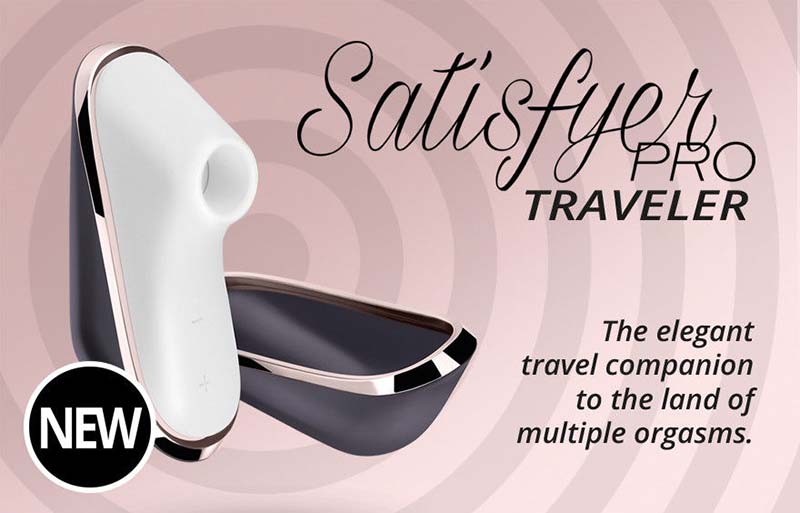
Benefits of the Satisfyer Pro Traveler
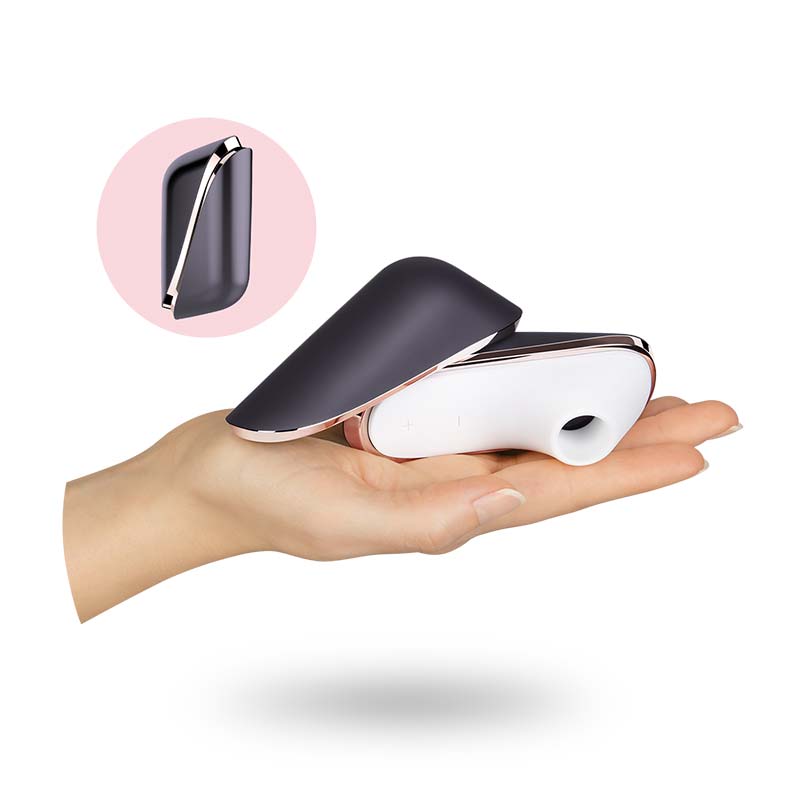
It’s 4.85 inches of dynamite! Use the Satisfyer Pro Traveler to stimulate powerful orgasms. This wonder of a device is compact and easy to pack away conveniently in your travel bag, or even a purse.
To save you the mortifying situation of having a vibrator turn itself on at the wrong time, the device is equipped with an ensuring travel lock which makes it the perfect companion to go on a long business trip with.
It snuggly rests on the vulva and works effectively on the clitoris and it will make your eyes roll back and your toes curl non-stop.
The Satisfyer Pro Traveler is easy to operate with an ocean of orgasmic waves that can take you to sexual Utopia.
There are 11 settings that toggle through just two buttons.
You get the utmost control for a variety of experiences. Alternate from gentle stimulation to very strong stimulation.
-
Claims of the Satisfyer Pro Traveler
This will make you tap out! It is engineered to stimulate your clitoris to an instant orgasm – the team at Satisfyer certainly know how to light a fire in between your legs.
-
Waterproof
You can use this vibrator in the water as you shower or take a bath. It has a waterproof function that doesn’t disappoint.
-
Convenient to use.
When you have to smuggle in a quickie before you leave for work with a clearer head. For those who prefer to use it at home, it is ideal to use it on yourself or with the help of a lover.
Relax into a well-deserved long bath after a long day making all your cares float away.
-
Low noise
Worrying about the buzzing noise that comes from most vibrators in the market is a thing of the past. The Satisfyer motor is super quiet, ensuring that you engage in self-pleasure without any self-consciousness.
You will increase your guarantee of reaching climax very easily as you lose all your inhibitions and let waves of orgasms easily rush through your body.
Features of the Satisfyer Pro Traveler
- 11 operational settings
- Magnetic USB cable
- Waterproof
- Skin friendly silicone
Caring and cleaning the Satisfyer Pro Traveler
Cleaning your Satisfyer Pro Traveler is a very easy task. You can wash the toy with mild soap and warm water. To get the most out of your efforts use sex toy antibacterial cleaner.
Who is the Satisfyer Pro Traveler for?
Although taking matters into your own hands is a one-woman job, you don’t have to always be a lone wolf when it comes to using the clitoral stimulator. It is a major turn-on for men to partake in the experience and even use the toy on you from time to time.
The clitoral stimulator is a great way for men to get to know their partner’s erogenous zone and what intensity level their lover requires to reach orgasm.
When it comes to receiving a helping hand, it is always helpful to share your toys especially when it comes to receiving realistic oral sex from a Satisfyer.
Cons of the Satisfyer Pro Traveler
-
Sound
A little bit of length would make it more popular with the ladies. At least, seven inches in length is the ideal size to tickle a lady’s fancies.
-
Colour
When it comes to colour, black and white may not be the coolest to get excited about. It can make the whole experience feel a bit robotic and less fun. So, why not mix it up with some vibrant colours?
Pros of the Satisfyer Pro Traveler
-
Size
A compact size of the vibrator is the most convenient feature of the Satisfyer Pro Traveler. You can easily just pack it in a bag and take it with you anywhere.
-
Low vibrating sound
When you’re using the vibrator, it’s pretty tough to hear it buzzing. This is great because it helps you avoid feeling embarrassed that others might hear it.
-
Usability
Perfect for use in the shower and bathroom. Playtime is not just limited to the bedroom like most clitoral stimulators.
You can soak in the benefits while adding an extra advantage of not needing any lubricant to heighten the endeavour.
Conclusion about the Satisfyer Pro Traveler
The phrase “if you want something done, do it yourself” has never been truer.
Satisfyer Pro Traveler is the closest guarantee to an orgasm that you will get at this price – if at any price at all.
Control over your experience is what you gain the most with the user-friendly settings – with just two buttons.
You can’t put a price on pleasure, get this now.

Be sure to stop by Adultsmart to buy a Satisfyer clitoral stimulator so that you can have one of your very own today!

Meet Rick, Adultsmart’s owner with 35+ years in the adult industry. A sex blogger, advocate for gender and sexuality equality, offering a diverse product range.






Leave a Reply