In solidarity with the internet world I am joining the #metoo movement currently happening. Now if you haven’t been online over this past weekend, you might be wondering what the #metoo movement is or what I am talking about? A little over a week ago, a major movement began in the Hollywood circle with sexual assault and harassment charges brought forth by one of the industry’s most notable figures. Start fighting sexual harassment and assault with this movement.
Are These Allegations Unheard Of?
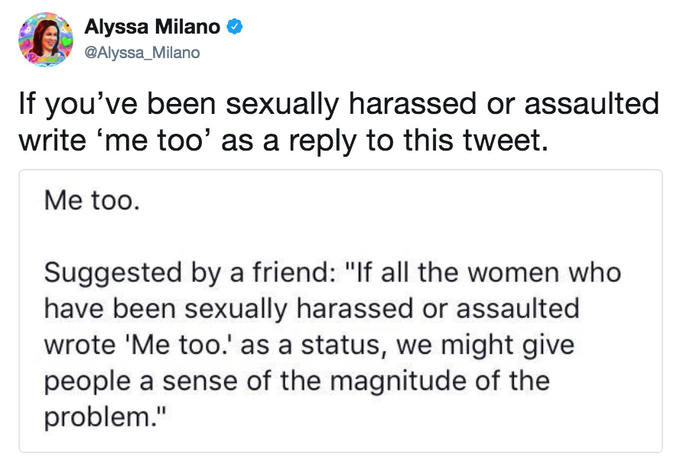
These allegations are nothing new, countless incidents have been brought forth against countless people for years and years. What makes this instance so unique is the backing support it has received from women and men around the world who have had enough, in particular Alyssa Milano (Who’s the Boss, Charmed) started a tweet:
Image: Alyssa Milano’s #MeToo Tweet
“If all the people who have been sexually harassed or assaulted wrote “Metoo.” as a status, we might give people a sense of the magnitude of the problem. #MeToo”
Photo: Alyssa Milano
Everyone Came Together From Around The World
This tweet has sparked a viral online movement and one that is causing a number of debates amongst its own supporters. I first started seeing this post specifically calling for “Women” who’ve experienced these forms of harassment and assault to come together in solidarity, soon after I started seeing men, women and non-binary identifiers also posting their stories, or simply indicating a #metoo.
For many this is a movement to bring awareness to the harassment and mistreatment of WOMEN that has been swept under the rug for too long. Others are proclaiming this is the opportunity to show that sexual harassment, assault and rape are not just a Women’s issue, but rather everyone’s issue. 1 in 4 girls will be sexually mistreated in some way before they are 18, that same statistic applies to 1 in 6 boys.
Thanks To This Equality Is Moving In The Right Direction
I’d say this is everyone’s issue and in 2017 when the movement for equality has made more stride than ever before, there’s no better cause to come together for.
Now that you have a little more information about the #metoo trend happening around you, I’d like to take this time to share my experience.
As a man, and for one who grew up in rural Canada surrounded by every hegemonic masculine stereotype you can imagine, I endured physical and mental harassment from peers in school for being different. I personally never gave much thought to sexual harassment and how it would, could and did eventually affect me.
My Experience #Metoo
When I was 19 or 20 I had been casually “seeing” a guy for some time, we went to movies, shared dinners etc. On this particular night which happened to be his birthday, he had people over to his condo for drink and celebrations, nothing unusual here. I turned up later than the rest of the guests as I had prior commitments.
When I arrived everyone was well into the celebrations, him included. Everyone was full of love and laughter, the night was just like any small birthdays you’ve been to. As the guests levels of intoxication grew the party dwindled down, having arrived later I was leagues behind where this guy was on the drunk meter. As the last guests were leaving, I decided I would head home as well, but first to put this guy to bed. We had been seeing each other for a while and known each other longer; I thought the nice thing to do would be to make sure he was comfortable in bed.
He Was Way Too Drunk
After leading him from a half passed out position on his recliner to his bedroom, his energy level picked right up. The whispers of seduction were pouring from his lips, I playfully laughed it off and told him I was putting him to bed and I would see him the following day (I’m not one for drunk sex). He began kissing me and soon we were horizontal on the bed. I played it off with laughter and repeatedly telling him I was tucking him in and walking home… alone!
The seductive moves began to get more forceful with one hand on my wrist and soon followed by the second. Even at this point, pinned to a bed, a man much larger than myself on top, I still didn’t feel like I was in a situation of assault. In my mind he was drunk. I began repeating for him to let me go, admittedly I was laughing and smiling through this.
He Would Not Take No For An Answer
I continued to repeat myself, when his knees began pushing against my legs, still pinned at the wrists and the full weight of this man atop me I began to feel for lack of a better word claustrophobic. It was this feeling at the time that prompted me to use my head. Literally, when he leaned in to kiss my face or neck or wherever he was aiming I threw my forehead into his face. It was like lightning, his grip released my hands and I rolled off the bed in one movement.
I didn’t say a word, I don’t even remember leaving his apartment. I remember walking down the nearly deserted city street walking with as much “unf” as I could muster, it was about a 30 minute walk from his place to mine. To be honest I don’t remember getting home, or what I did with myself. I don’t remember being scared or upset at what had happened. As I said before, in my mind it was the alcohol. I chalked up what had taken place to the results of alcohol.
I Put Blame On Myself
It wasn’t until the next morning that I found my t shirt with blood splatters across the front.
Perhaps putting the blame on something intangible, kept me and my brain from re living and mentally playing over the events to determine his actual motives. I didn’t “date” this guy again, I just lost interest. I never acknowledged within myself that I might have ill feelings towards him or in fact I didn’t think about it again for years.
The effects of that night did dawn on me years later, while dating another person who suffered from alcoholism (I’ve dated some winners). During this relationship after his countless benders he would always end up apologising for this and that, he would always blame it on the alcohol. After a few repeat offences and repeat apologies from this guy I knew it wasn’t the alcohol that lead to this behaviour.
Alcohol Only Lowers Your Inhibitions
The alcohol just lowered the inhibitions that would tell someone “it’s not a good idea”. Alcohol doesn’t make you do things out of nowhere, it just lowers your sense of judgment and inhibitions.
After the later relationship ended I was out at an event in Vancouver and I bumped into “the guy”. All was well until he approached me outside the venue. He began the conversation as if his birthday night was the other day and not years prior. He was apologetic, he was afraid, he was ashamed. I didn’t know how to react, the emotions I was feeling in that moment were too overwhelming and came out of left field.
I Forgave Him To Move Forward Myself
I hadn’t acknowledged my own hurt and here he was exploding his. I did the only thing I knew how to do, and that was to accept his apology as cordially as I could and smiled then answered a fake phone call, told him I needed to take it and proceeded back inside the venue to my friends.
Now years later since all of this has happened and as i reflect on the situation as a whole i am left with more questions. What I should have said to him? Did he deserve that platform to express himself? Did his words bring up more trauma than healing?
No two situations are the same, no two people go through the same emotional process. That is what is so tricky with situations like these, not every matter is black and white. The one thing that is for sure is that your body is yours alone, no one has dominion over it but you.
No Two Situation Are The Same And It Is Never Easy
I have shared my #metoo story along with many others. And I question what good will it do? I might be able to sit here and recount this story, countless others who’ve gone through their own situations may not and that doesn’t make their story any less important or imperative to this movement. No one is entitled to another’s story, nor is anyone obligated to share their story. These are personal offenses and take a personal journey to deal with.
See the wisdom of Patrick Kriz, a Psychology, Human Sexuality graduate. An articulate and educated expert, his writings enrich sexual wellness and lifestyle.
To provide the best experiences, we use technologies like cookies to store and/or access device information. Consenting to these technologies will allow us to process data such as browsing behavior or unique IDs on this site. Not consenting or withdrawing consent, may adversely affect certain features and functions.
Functional
Always active
The technical storage or access is strictly necessary for the legitimate purpose of enabling the use of a specific service explicitly requested by the subscriber or user, or for the sole purpose of carrying out the transmission of a communication over an electronic communications network.
Preferences
The technical storage or access is necessary for the legitimate purpose of storing preferences that are not requested by the subscriber or user.
Statistics
The technical storage or access that is used exclusively for statistical purposes.The technical storage or access that is used exclusively for anonymous statistical purposes. Without a subpoena, voluntary compliance on the part of your Internet Service Provider, or additional records from a third party, information stored or retrieved for this purpose alone cannot usually be used to identify you.
Marketing
The technical storage or access is required to create user profiles to send advertising, or to track the user on a website or across several websites for similar marketing purposes.
To provide the best experiences, we use technologies like cookies to store and/or access device information. Consenting to these technologies will allow us to process data such as browsing behavior or unique IDs on this site. Not consenting or withdrawing consent, may adversely affect certain features and functions.
Functional
Always active
The technical storage or access is strictly necessary for the legitimate purpose of enabling the use of a specific service explicitly requested by the subscriber or user, or for the sole purpose of carrying out the transmission of a communication over an electronic communications network.
Preferences
The technical storage or access is necessary for the legitimate purpose of storing preferences that are not requested by the subscriber or user.
Statistics
The technical storage or access that is used exclusively for statistical purposes.The technical storage or access that is used exclusively for anonymous statistical purposes. Without a subpoena, voluntary compliance on the part of your Internet Service Provider, or additional records from a third party, information stored or retrieved for this purpose alone cannot usually be used to identify you.
Marketing
The technical storage or access is required to create user profiles to send advertising, or to track the user on a website or across several websites for similar marketing purposes.









Leave a Reply